Tuesday, September 10, 2013

Rodenticides....Unintended Consequences

 If it’s sold on store shelves, it must be safe…right? Not always.

In 2008, the U.S. Environmental Protection Agency (EPA) released new safety measures intended to reduce children’s exposures to rodenticides in the home and reduce risks to wildlife. These measures were to be implemented by 2011 but not all companies complied with the measures.  In response, the EPA recently took action to remove 12 rodenticide products from the market but pending litigation has stopped the ban for now. 

So what’s all the concern since rodenticides kill rodents?  Yes, rodenticides contain active ingredients that kill rodents in varying ways. However, they can also kill or seriously compromise the health of non-target wildlife, children and pets. The Red-tailed Hawk, Great-horned Owl, Bobcat, Mountain Lion, Gray Fox, Red Fox, Black Bear, and Turkey Vulture, to name a few, are species that can be negatively impacted by rodenticides.  In California, the Department of Pesticide Regulation (DPR) has determined that impacts to non-target wildlife by second-generation anticoagulant rodenticides are a statewide issue and is proposing new regulatory action (No. 13-002) to designate those rodenticides as restricted materials and limit the placement of aboveground baits.

So what are rodenticides? Rodenticides are pesticides that contain active ingredients that can be classified into three types: 1) acute toxicants (AT’s), 2) first-generation anticoagulant rodenticides (FGAR’s) and 3) second-generation anticoagulant rodenticides (SGAR’s), and they are placed indoors or outdoors in tablet, pellet and/or paraffin block form. They can even be contained in bait stations. Acute toxicants work in several ways such as impairing nerve cell action or causing cell death.  With anticoagulant rodenticides, the animals’ blood loses its clotting ability and capillaries are damaged, causing the individual to die from internal bleeding. With FGAR’s, animals must consume the rodenticide several times to accumulate a lethal amount of toxin in their body and some animals became resistant to the active ingredient(s).  Therefore, SGAR’s were developed that are more toxic and designed so that lethal concentrations are consumed in just one feeding.  However, it takes several days for the rodent to die during which time it can return to feed on the rodenticide, building up extremely high concentrations in its tissues.  If it becomes prey for predators, those high concentrations of rodenticides are passed to the predator and can be lethal or compromise the non-target animals' health.  

 Aside from direct death due to anticoagulant toxicity, wildlife exposure to anticoagulant rodenticides can weaken an animals' immune system, making it vulnerable to other diseases/infections such as mange, a disease caused by a parasitic mite. Mange causes intense itching, hair loss and eventually thickening of the skin if the host animal is not healthy enough to fight the infestation.  Eventually, the skin may tear leading to bacterial infections and death.  A study conducted in the Santa Monica Mountains (Riley et al 2007) determined that two (2) mountain lions died as a direct result of anticoagulant toxicity, 90% of dead bobcats tested positive for anticoagulants and there was a high level of association in bobcats between severe mange and anticoagulant exposure. In the Puente Hills, one bobcat tested positive for anticoagulants rodenticides, at least one other bobcat died with severe mange while a third with severe mange was captured, treated and re-released. 

Currently, numerous cities and counties are showing support for the EPA and DPR by passing resolutions opposing the sale, purchase and use of certain rat and mouse poison products that pose an unacceptable risk to children, pets and wildlife.  The Board of Directors for the Puente Hills Habitat Preservation Authority passed one such resolution in August 2013 as did the City of Whittier in July 2013.  You can have your voice be heard by submitting comments to the California DPR on their Notice of Proposed Regulatory Action No. 13-002 by October 4, 2013, before 5:00 p.m. More information can be found at: 


Tuesday, April 2, 2013

Stop, look, listen!


If you’ve hiked in the Puente Hills you’ve probably heard drumming on trees or noticed horizontal holes drilled into trees with sap flowing from them; all courtesy of a group of birds called sapsuckers.  Sapsuckers belong to the bird Family Picidae that includes woodpeckers.  There are about 200
species of picids worldwide, of which two species of sapsuckers, Red-breasted sapsucker (Sphyrapicus ruber) and the red-naped sapsucker (Sphyrapicus nuchalis), have been confirmed on Habitat Authority managed land. 

The Red-breasted Sapsucker is a medium sized woodpecker with a red head, nape, throat and breast, cream colored belly, white rump and white moustache stripe.  Preferring to drill sap wells in riparian species, they inhabit forest edges and woodlands.  Breeding occurs from Alaska and British Columbia south to California and wintering grounds are located throughout most of their breeding range. They are cavity nesters and drill out new nest cavities typically annually.  Their diet consists of sap, arthropods and some fruits. 

Red-naped sapsuckers differ in that they have a red head and nape, cream breast and belly.  They breed in the Rocky Mountains and winter in southern California typically along the edges of forests and woodlands, especially groves of aspen and alder.  They are also cavity nesters and their diet consists of sap, arthropods and some fruits. 

Sapsuckers use their strong bills to drill sap holes, collectively called sap wells, into living trees and eat the sap along with some insects that are attracted to, and get trapped by, the sap.  The shape and size of the sap holes differs by species and the holes drilled in these pictures were likely made by the red-breasted sapsucker.  These sap wells can also be an attractant for species like hummingbirds who eat the sap that the sapsucker keeps flowing.  Large sap wells can cause extensive damage to trees leading to tree mortality while other times trees can heal themselves and continue growing.  Not all activities of sapsuckers are problematic.  Sapsuckers usually excavate new nests every year, leaving old nesting cavities for a variety of woodland/forest species to inhabit. 

So when you’re out on the trail, keep your eyes and ears open for these wonderful birds!


Friday, February 10, 2012

Something is bugging our oaks...

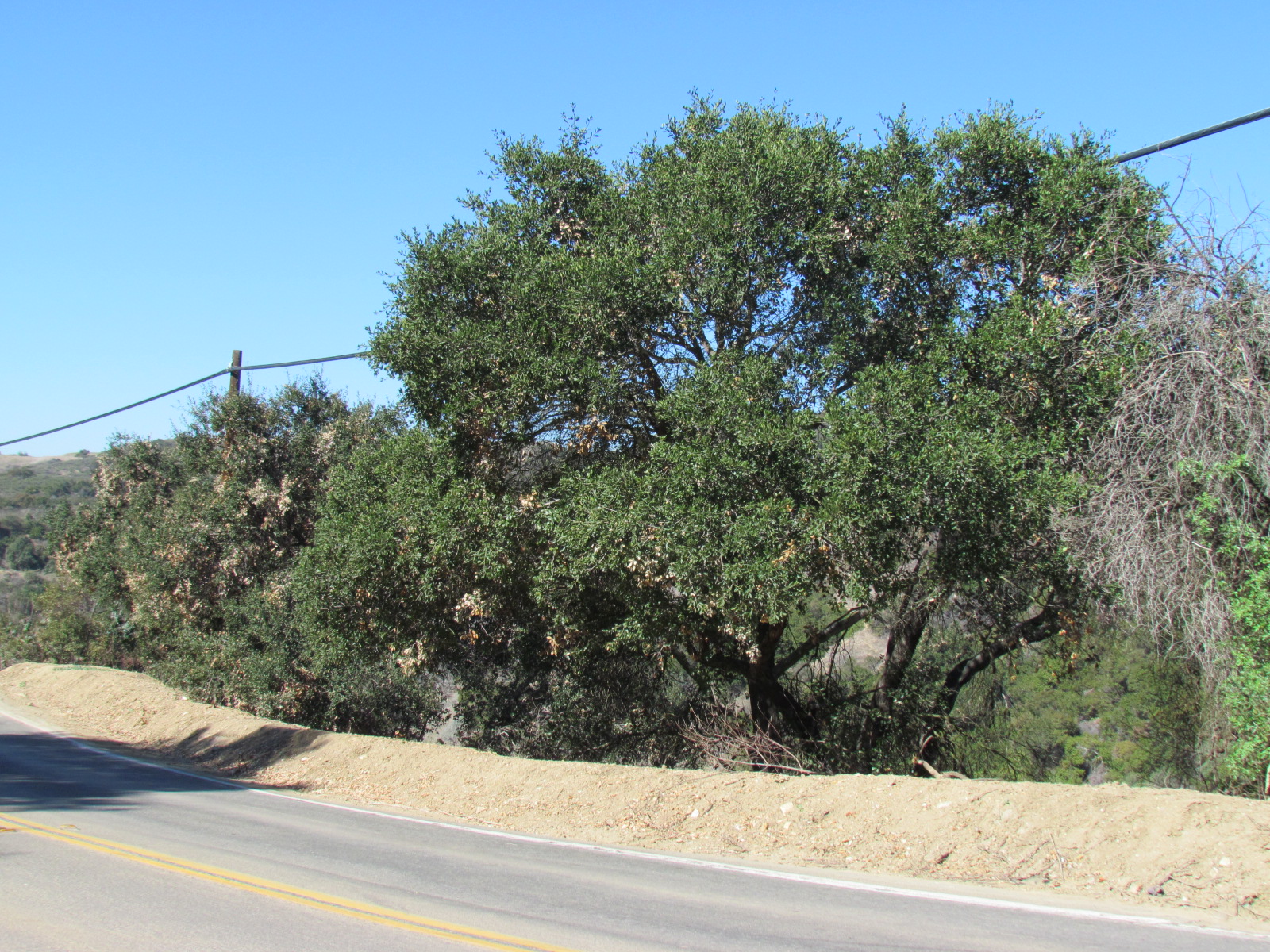
Over the last few years, I’ve noticed that the large coast live oak trees along Turnbull Canyon Road appear to have small patches of dead leaves on them, but the trees appear to be healthy otherwise. For a while, I dismissed the dead leaves as a symptom of drought. But as I was made aware of a devastating new pest that is affecting oaks in San Diego County, called the gold-spotted oak borer, I’ve been paying a bit more attention to trees that appear distressed. Although there could be several things causing the dead leaf patches on our oaks, including other insect pests and fungi, I became concerned that these oaks could perhaps be affected by the gold-spotted oak borer. So, I examined some of them closely.

While gold-spotted oak borer attacks can cause thinning of the tree crown and die-back of twigs, none of the trees appeared to exhibit any of the classic symptoms along the trunk, such as weeping or staining, or tiny D-shaped exit holes. What I did find was at the point where the dead twigs met with the live tree branch, under the bark there was a pattern etched in the tissue spiraling around the twig, with dark powdery “frass”inside the tunnels (see photo) – I even found a tiny larva in one! This indicated that the damage could be caused by an insect called the oak twig girdler. It is similar to the gold-spotted oak borer, in that they are related – gold-spotted oak borer’s scientific name is Agrilus coxalis, and the oak twig girdler’s scientific name is Agrilus angelicus. Also, both attack the tree’s tissue just below the bark, causing the growth beyond the attack site to die. However, the gold-spotted oak borer attacks the trunks of trees, whereas the oak twig girdler only attacks the smallest twigs at the ends of branches where new growth is happening. That is why the gold-spotted oak borer is much more of a threat, because when it attacks the trunk tissue, it prevents nutrients from reaching the rest of the tree (branches and leaves).

The larva I collected is being sent to the Los Angeles County Department of Agricultural Weights and Measures for entomologists to confirm whether it is the oak twig girdler. Fortunately, the oak twig girdler is not considered to be a significant impact to tree health. But the presence of these insects may be a sign that our oaks are under some stress, as the oak twig girdler is thought to be attracted to trees weakened by drought.

**UPDATE: The Los Angeles County Entomologist confirmed that this is likely the oak twig girdler, and that it is not a cause for concern. He also mentioned that this is a native species.

Wednesday, December 28, 2011

Should you be afraid of bobcats?

We at the Habitat Authority have gotten several calls over the years from local residents or hikers asking this very question. It is understandable for people to be afraid of things they are not familiar with, and given the relatively reclusive and secretive nature of bobcats, most people never see bobcats.

Some people are afraid of bobcats because they associate them with mountain lions. It is true that they are both wild felines. However, bobcats are much smaller than mountain lions (about 10 times smaller), and are only about the size of a beagle or about twice the size of an average housecat. (They also look quite different, with bobcats having short “bobbed” tails and a striped or spotted body, whereas mountain lions have a very long tail and are a uniform tan color). Given their small size, they also eat smaller prey than mountain lions; bobcats generally eat rabbits or rodents, while mountain lions almost exclusively eat deer.

Although there are rare reports of mountain lion attacks on people (none in the Puente Hills area), there are almost no records of bobcat attacks on people. The few credible reports that do exist generally have to do with a rabid bobcat, which is quite unusual. No reports of rabid wildlife of any kind have been reported to the Habitat Authority.

Bobcats, like mountain lions, generally avoid people and areas inhabited by people. They tend to be found less often along trails with higher recreational activity, and they often shift their activity to occur at nighttime in areas frequented by people in an effort to avoid them. Bobcat home ranges occur much more frequently in natural habitat compared to areas within or near developed areas.

If you see a bobcat in your neighborhood, it probably means that you have a lot of natural vegetation in the area. If there are a lot of rabbits or rodents in your neighborhood gardens, that might also attract bobcats. If you want to keep bobcats or other wildlife out of your yard, consider installing fencing around your immediate use area, make sure to clean up fallen fruit or other potential food items (trash, bird seed) that might attract rodents, keep small pets indoors and/or closely supervised, and never intentionally provide food or water to wildlife.

There is no reason to fear bobcats, but bobcats have plenty of reasons to fear us. In most remaining natural areas in southern California, bobcats have to face many challenges in order to survive. One major challenge is crossing numerous busy roads safely. Another challenge is not becoming infected with diseases which could be passed on from other animals or even domestic pets, and not eating rodents that have been poisoned; rat poisons contain anticoagulants and are shown to have a possible association with a disease called mange. Another challenge is finding large enough patches of habitat that are relatively free from human disturbance in order to live and rear their young.

If you do see a bobcat, you should consider yourself very lucky! Seeing a bobcat is a good way to remind us of the wildness that is still present in our area.
(Photo credits: top - Doug Wolfe, drawing - Cougar Network, time-stamped - Puente Hills Habitat Preservation Authority)

Thursday, December 1, 2011

What’s Lurking in your Firewood?

With winter just around the corner, you may be starting to buy firewood. But besides the usual critters that hang out with firewood, such as spiders or scorpions, there may be another, much more dangerous threat that is too small to see. That threat is from a small beetle, called the gold-spotted oak borer. As its name suggests, it bores into oak trees, and it eats away at their critical vascular tissue, eventually killing them. As of 2010, this beetle has killed an estimated 21,500 trees covering 1,893 square miles in San Diego County in forests, parks, and residential landscapes.

Fortunately, there are no known occurrences of the gold-spotted oak borer in Los Angeles or Orange Counties. Unfortunately, it is known to occur in not-too-distant San Diego County. If firewood from oak trees in San Diego County is transported elsewhere, it could spread the gold-spotted oak borer into new areas. When firewood is harvested, the beetle may be present in its larval stage, feeding off of the oak’s tissue beneath the bark. When that oak that becomes firewood, the beetle is transported along with the firewood. By late spring, the beetle transforms into its adult stage, with wings, and it flies out of the wood to find new oak trees on which to lay eggs. These eggs hatch into larvae, which bore into the new oak tree, and the cycle begins again.

Currently, there is no known effective remedy or treatment for the gold-spotted oak borer. Sometimes infested oak trees must be killed before others are affected. Our native coast live oak trees not only help to define the beauty and naturalness of the Puente Hills area, but also provide food and shelter for numerous invertebrates, birds, and mammals. Their importance is reflected by the fact that they are considered a protected tree species by Los Angeles County, and oak woodlands are also protected by the State. Oaks also provide shade for homes, and can even add to property values. Oaks continue to be lost to land development and other impacts, and it is important to retain and protect the remnant patches that remain. Therefore, the best hope we have in protecting our oak trees from further loss due to the gold-spotted oak borer is to prevent it from getting here in the first place. Please, check on the source of your firewood before you buy it, and avoid buying oak firewood from San Diego County. Or, if you have already purchased wood from there, burn it right away and burn it thoroughly. Help protect the beauty and natural value provided by our native coast live oaks.

For more information, visit these websites:
www.ucanr.org/sites/gsobinfo
www.cisr.ucr.edu/goldspotted_oak_borer.html


(photo credit for picture of gold-spotted oak borer: http://www.ucanr.org/sites/gsobinfo/)

(photo credit for picture of firewood: http://firewood.ca.gov/)

Friday, November 4, 2011

Mixed Nuts

As some of you may be aware, parts of the Puente Hills Preserve support a rare species of native tree, the Southern California black walnut (Juglans californica). These Puente Hills are one of the handful of places in Los Angeles County where this tree is found, and it generally only grows on more moist north-facing slopes or in shady canyons. It is often found growing with another native tree, the coast live oak. In the Preserve, it can be found in the Powder Canyon and Hacienda Hills areas. The presence of walnut woodlands in the Preserve is one of the reasons that the Puente Hills was recently selected for possible inclusion in a new National Recreation Area that could encompass parts of the San Gabriel Mountains and Watershed.

The native black walnut is similar to the cultivated walnut that we buy at the grocery store, in that they both produce walnuts (although the native is smaller). One such cultivated walnut is the English walnut (Juglans regia), which is related to the native black walnut – since they are related, they can and sometimes do hybridize with each other. In the early 20th century, horticulturalists were conducting experiments hybridizing black and English walnuts, including Luther Burbank (in Santa Rosa, Northern California) and the University of California Department of Agriculture. The latter planted one of these hybrid trees in 1907 in the City of Whittier, known as the Paradox Hybrid, where it still stands today at about 14 feet tall and about 100 feet in diameter – an enormous, gorgeous tree (see photo below)! It is actually a Registered State Historic Landmark Number 681 (located on Whittier Boulevard near the intersection with Mar Vista).


If you hike in Powder Canyon and look closely at the walnut trees you may notice that a few of the trees are much larger, and have much larger leaves, but have very few fruits (often none). That is because some are the native black walnut (the smaller trees with smaller leaves and lots of fruit - at left) and some (possibly 5%) are the black-English walnut hybrid (the larger trees with larger leaves and few fruit - at right). The bark of the native black walnut is very furrowed or “grooved”, whereas the hybrid has either smooth bark (like the English walnut), or bark that is somewhere in between. So how did these hybrids get there? One possibility is that they are the result of black walnuts hybridizing with a nearby English walnut that was planted on someone’s property, perhaps one of the commercial walnut orchards that used to be more prevalent in the past. Another possibility is that these were planted as acorns from a hybrid, possibly even from the Paradox Hybrid in Whittier. This latter seems likely, considering that several resources have noted that the second generation hybrids (meaning those trees grown from seeds of the hybrid) bear very few fruit, which is the case for those hybrids seen in Powder Canyon.

Regardless of their native or hybrid status, the walnuts in the Preserve provide important food and shelter resources for many species of insects, birds and mammals, and are a beautiful and shady addition to our trails.

Friday, October 7, 2011

Cozy Camera


Surprise! That is what I think every time I download the digital photos from our motion-sensor cameras located throughout the Preserve, because I never know what fun surprising wildlife photos I’ll see. But sometimes I’m also surprised by what I find inside the camera itself. Occasionally I’ll find a spider making a web, or a colony of pincher bugs. But this week I found something quite surprising – a nest! And no, not a bird’s nest; nesting season is pretty much over by now for birds, generally ending in August or September. It was a mouse nest! I believe they are common deer mice based on their orange-brown fur on the top of their bodies, and the white fur on their underside, as well as their size and ears.


Deer mice can reproduce almost any time of year, especially in our moderate climate, and use a variety of places to build nests. Apparently there was just enough of space for them to wedge into the metal box which houses the camera, and build a fluffy, cup-shaped nest. Nests are often constructed out of grasses, moss, wool, fibers, and thistle down. This nest appears to be constructed mostly of pappus from thistle seeds (“thistle down”) – this is the fluffy stuff that allows the seed to be carried off by the wind. I caught both of them as they were still constructing the nest, and when I went back to check a few days later, the nest was completed into a sphere with a hole in the top – and the female nestled inside (the male ran out of the box as I opened it). Their gestation period is about 3 weeks, so I’ll keep checking over the next few weeks to see if there are any baby mice.